
 CASE 01Demo
Games & playable prototypes
Build a fantasy prince-and-monsters game
Higgsfield’s own demo compares a fantasy-game task with Sonnet 5.5. Results depend on the platform workflow and were not independently reproduced.
@higgsfield_aiRECENTLY UPDATED / (SHANGHAI TIME)
CHEER LIN / ARCHIVE
Browse 35 public cases and demos explicitly attributed to GPT-6.1 Sol. Review the tasks, outputs, tool combinations, and creator accounts with original sources and evidence limits preserved.
USE CASE MAP / 01
Only public tasks and demos explicitly attributed to GPT-6.1 Sol are included. Each case links to its creator and source and separates the model’s role from external tools. Results are creator or platform reports, not independent reproductions.
HOW TO USE / 02
Find a task, then check the original source for inputs, tool dependencies, runtime conditions, and the reported result.
Use categories, search, and sorting to find concrete cases or demos relevant to your task.
Check the steps assigned to GPT-6.1 Sol and distinguish generated code, tool calls, and outputs produced by external tools.
Open the creator’s post to review inputs, runtime conditions, revisions, and reported limits.
Confirm the model’s actual availability and required external tools. Record time, cost, and whether the result meets your requirements.
REAL CREATOR CASES / 03
Up to five cases per row, with fewer columns on narrower screens. Select a creator to open the original case; images and videos load only when needed.
CASE 01DemoHiggsfield’s own demo compares a fantasy-game task with Sonnet 5.5. Results depend on the platform workflow and were not independently reproduced.
@higgsfield_ai CASE 02Demo
The author published Sol and Sonnet 5.5 outputs for a pool-party game made with Blender and Godot. This is a tool-assisted comparison, without an independent playtest.
@bijanbowen CASE 03Demo
The author reports a Mona Lisa SVG at Max with 11,890 editable vector paths and compares it with Sonnet. The SVG source file was not audited.
@diegocabezas01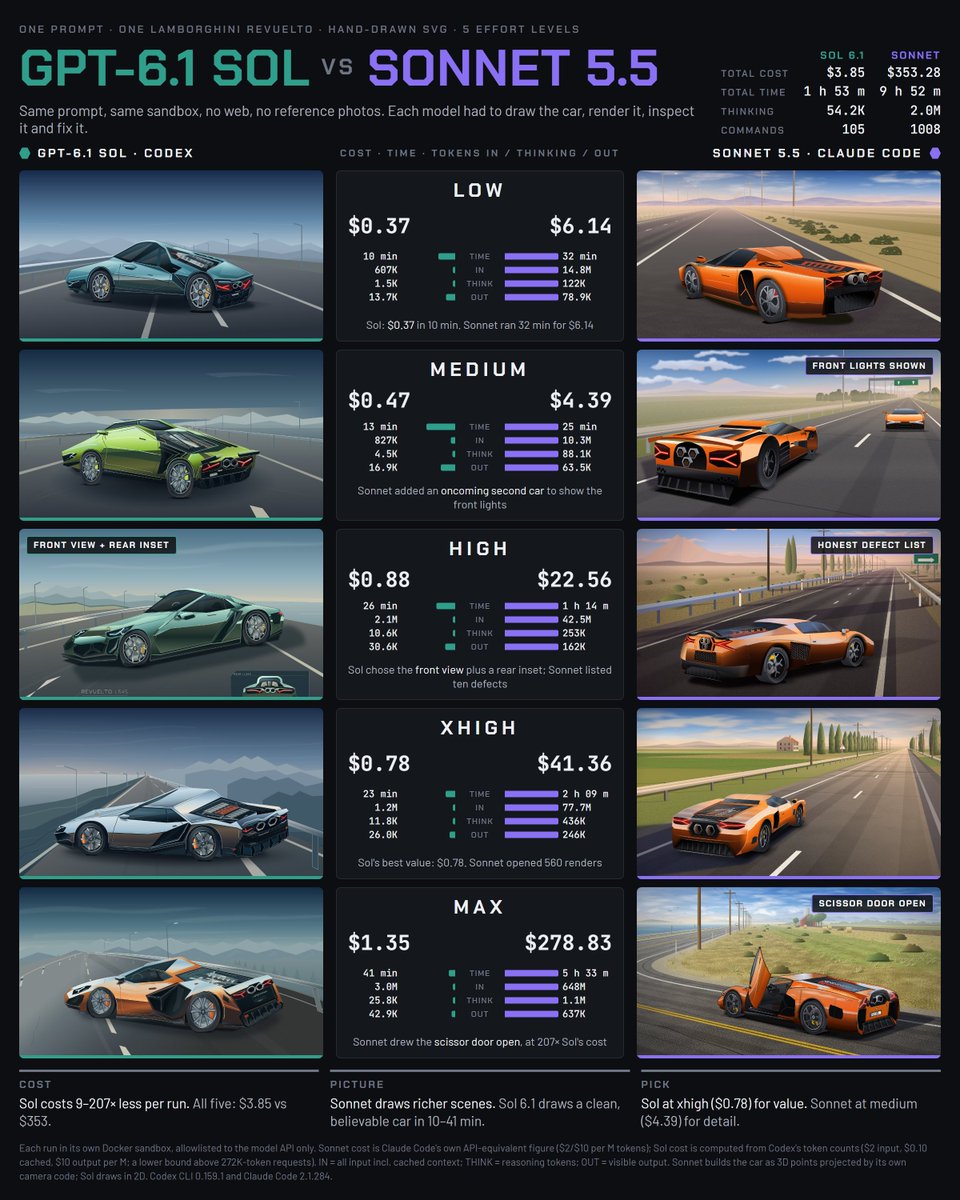 CASE 04Evaluation
Draw a Revuelto without web or photo references, render, inspect tiles, and revise. The author reports five effort levels for $3.85 in under two hours; costs and time are self-reported.
@aipulseda1ly CASE 05Demo
Higgsfield’s own demo compares Sol and Opus 5.5 on a high-speed ride through a cyberpunk city. The platform-made scene was not independently verified as a standalone playable game.
@higgsfield_ai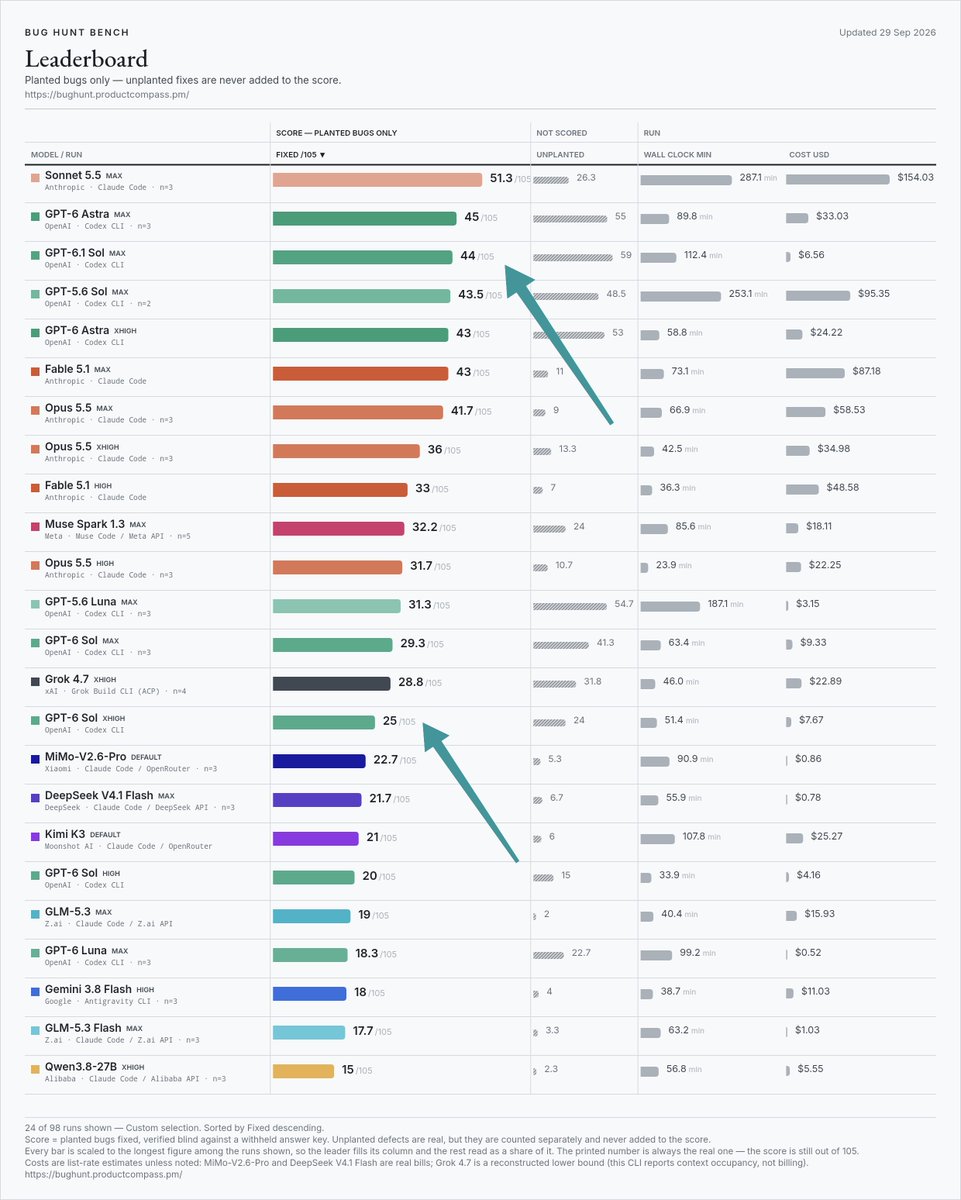 CASE 06Evaluation
The author tested two repositories with 105 planted bugs. Sol Max received a reported score of 44 at $6.56 in one run (n=1); 44 is not verified as a count of bugs fixed, and patches were not audited.
@PawelHuryn CASE 07Demo
Higgsfield’s own demo shows a product ad with animated typography and 3D visuals. It is a platform-assisted motion workflow, not direct video generation by Sol.
@higgsfield_ai CASE 08Demo
Higgsfield’s own demo gives Sol and Sonnet 5.5 a browser-based shooter task. The output depends on Higgsfield and Three.js; controls and gameplay were not independently tested.
@higgsfield_ai CASE 09Evaluation
A Codex Max scene reportedly took 52 minutes and 2.8 million tokens, using 2% of weekly allowance. The author reports a smaller city and lagging car animation; allowance usage is not an API bill.
@shownotover CASE 10Demo
Higgsfield’s own demo uses the same third-person-game prompt for Sol and Opus 5.5. It demonstrates a platform prototype; a complete standalone game was not independently verified.
@higgsfield_ai CASE 11Demo
Atomic Chat’s own demo compares Sol and Sonnet 5.5 creating a keyboard-assembly video. Claimed costs are publisher-reported; the output depends on Three.js and its rendering workflow.
@atomic_chat_hq CASE 12Evaluation
The author asked Sol to build the Eiffel Tower in Three.js and published the scene. They describe it as a poor result; this is one reported visual task, not a general model ranking.
@Bhavani_00007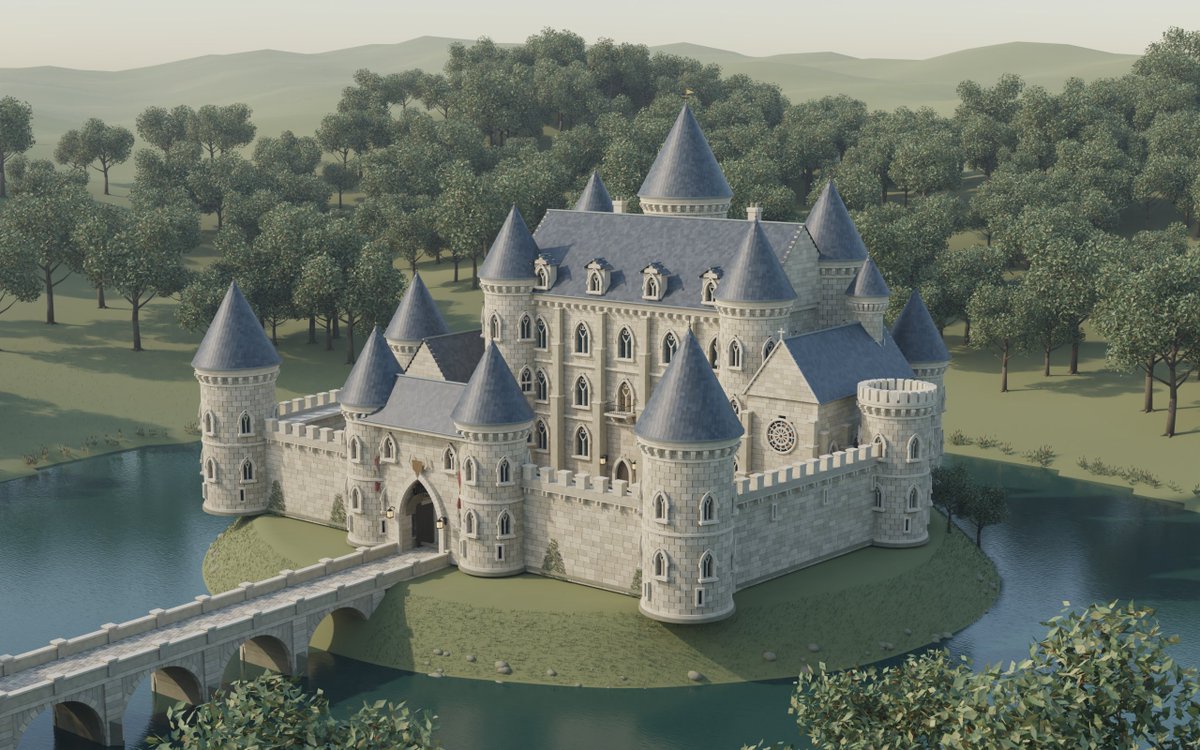 CASE 13Evaluation
The author published castle outputs and reports faster completion but a different interpretation of the goal from Claude. This specific visual comparison was not independently reproduced.
@nemumusitocha CASE 14Demo
The author reports building a Chinese–English subtitle overlay for U-NEXT in minutes, with a video demonstration. Pronunciation guides and vocabulary lists are proposed extensions, not completed features.
@turingou CASE 16Demo
The author used the same cyclist-animation prompt in Codex at xhigh for GPT-6.1 Sol and GPT-6 Sol, then published both results. The visual comparison was not independently reproduced.
@HarshithLucky3 CASE 17Demo
The author published a same-task Blender SpongeBob comparison with Sonnet 5.5. Blender is part of the workflow, and the quality verdict is the author’s rather than an independent audit.
@luckeyfaraday CASE 18Evaluation
BridgeBench’s own scene demo reports barely rendering an ocean and twice the time of Sol 6 at similar cost. These are publisher-reported results, without independent reproduction.
@bridgebench CASE 19Demo
Higgsfield’s own demo gives Sol and Astra the same 3D-game task. Its four-times-faster and one-fifth-cost claims are publisher-reported and depend on the platform’s tools.
@higgsfield_ai CASE 20Demo
The author compared Sol 6.1 and Sol 6 on the same landing-page task. Aesthetic and cost improvements are the author’s observations, without independent reproduction.
@blueemi99 CASE 21Demo
Higgsfield’s own demo uses drone footage for herd counts, tracking, and wandering-animal alerts. This platform-dependent software prototype does not establish real-farm detection accuracy or alert reliability.
@higgsfield_ai CASE 22Demo
The author tried a bear-cycling prompt with Sol at High. Savings from switching scheduled computer-use tasks are an expectation, not a measured result of this demonstration.
@libukai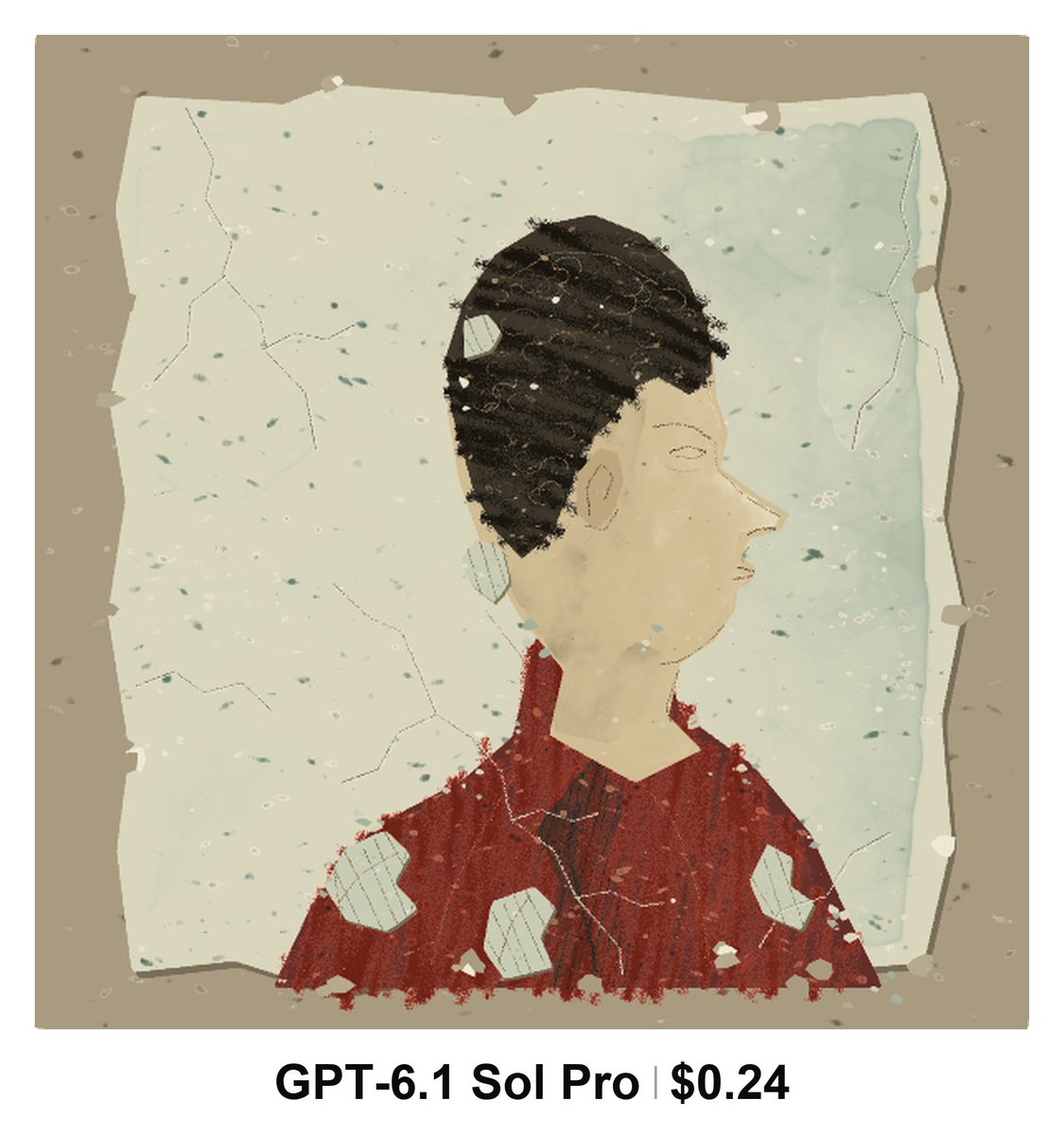 CASE 23Demo
The author asked Sol and Astra to draw JavaScript self-portraits. The Sol output is labeled “GPT-6.1 Sol Pro” and $0.24; that label does not establish a separate model endpoint or an audited cost.
@kickingkeys CASE 25Demo
The author posts Sol’s BridgeBench lava-lamp result. A concrete visual output is supplied; the subscription commentary does not establish a measured quality or cost advantage.
@bridgemindai CASE 26Demo
The author reports a partly pixel-styled game made in one shot, with no visible decrease in usage. This allowance observation is account-specific and is not a zero-cost claim.
@yugen_matuni CASE 27Demo
The author compares Sol, Astra, and Gemini 4 Pro on a 3D Colosseum prompt. Gemini is described as checkpoint 3, so this is not an equal-version controlled trial.
@LuminaBench CASE 28Demo
JetBrains’ own demo compares Sol 6.1 and Sol 6 on a photorealistic rocket scene. It reports 17 minutes and $0.553 for Sol 6.1; output depends on Three.js and the publisher’s tool workflow.
@jetbrains CASE 32Demo
Create a stained-glass maple leaf with thin borders, translucent tones, detailed veins, and beveled edges, and compare Max-effort outputs. The implementation tools are not disclosed.
@abhinavflac CASE 33Demo
Codex records describe Sol Medium fixing grips, wrists, fingers, and staff motion across six character animations, with a Frostwarden preview. Tripo, Blender, and Mixamo contribute; claimed Blender, FBX, and GLB exports were not independently inspected.
@luccacerf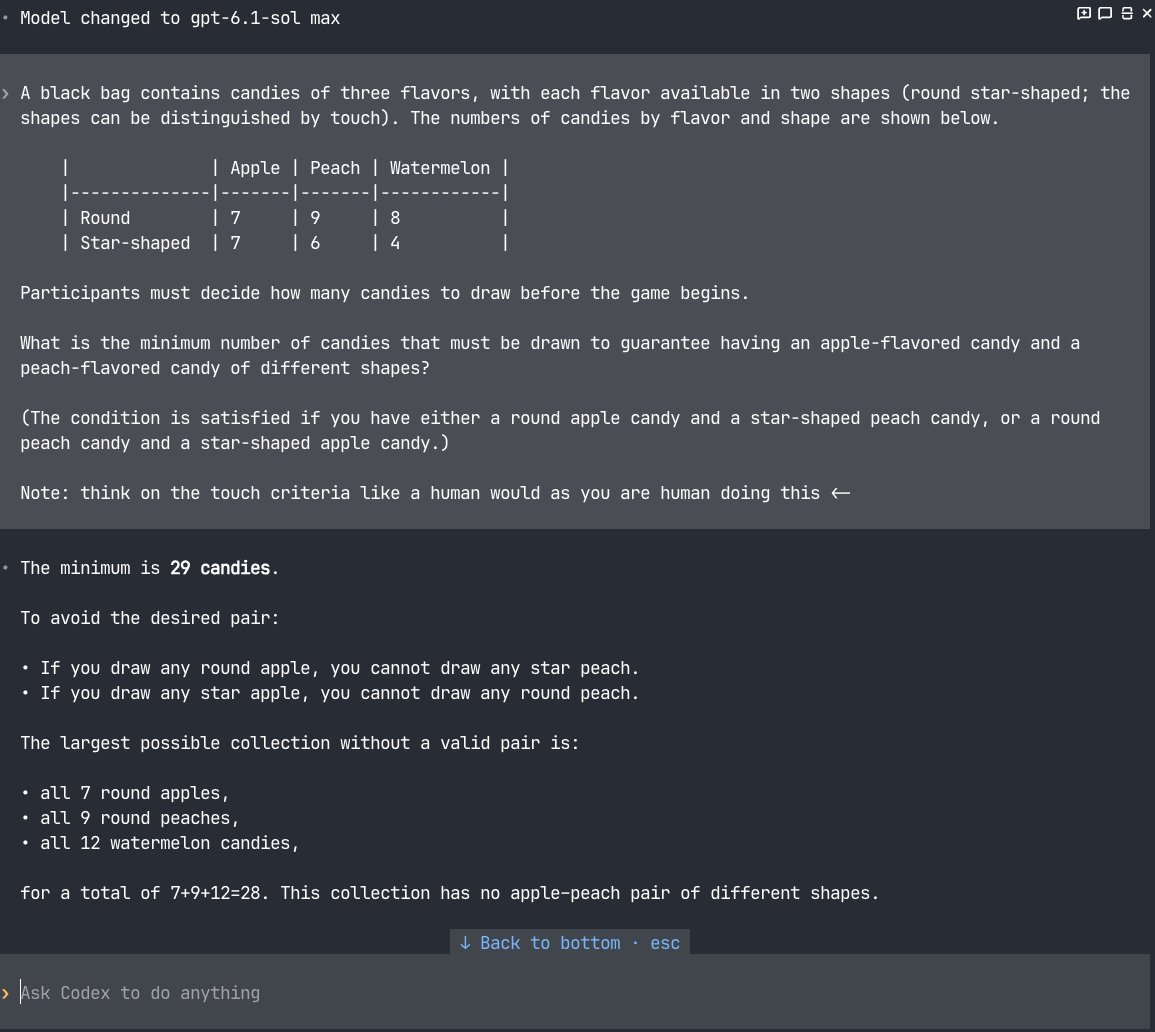 CASE 34Evaluation
Sol Max answers 29 on a candy shape-and-flavor guarantee puzzle. The author calls it a failure, but the answer was not independently recalculated. The claimed comparator version differs from the screenshot, so no precise version comparison is asserted.
@JinjingLiang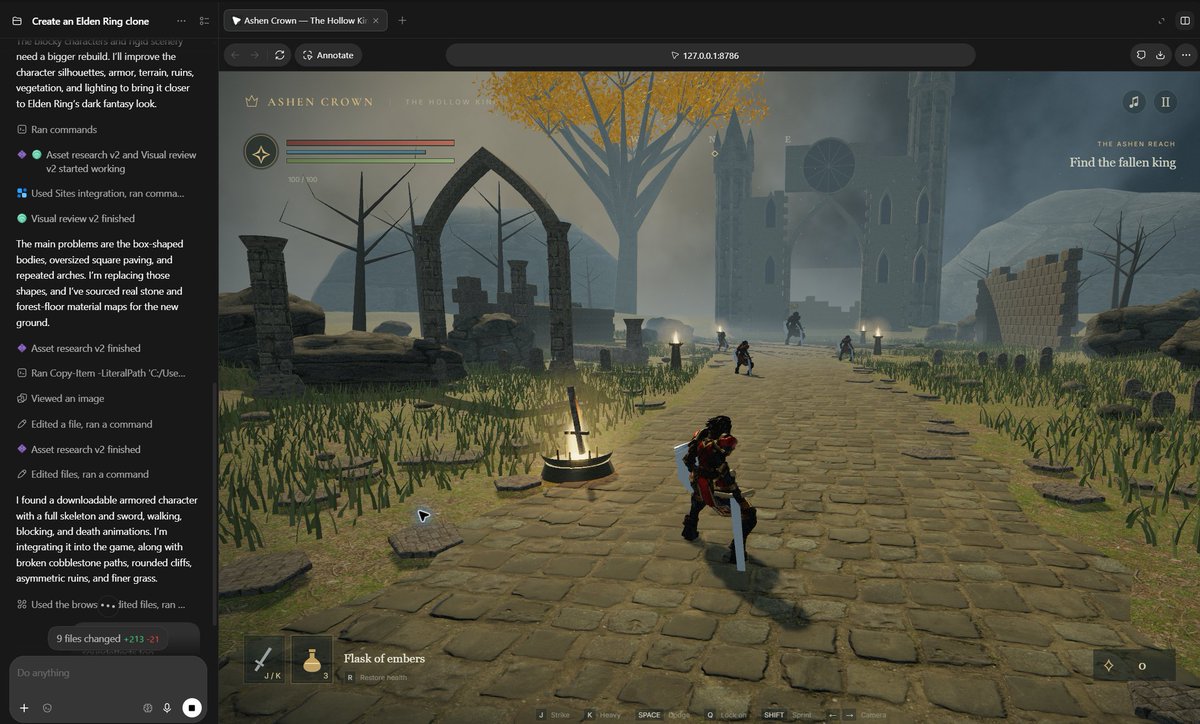 CASE 35Demo
Build an Ashen Crown dark-fantasy game prototype in Codex, using downloaded external character and animation assets. Model attribution comes from the source post; the demo does not claim that all assets were created from scratch.
@intheworldofai CASE 36Demo
Make Japan’s 47-prefecture map in one HTML file, in one shot and without web access, comparing Sol High and Sonnet 5.5 High. Geographic accuracy was not independently audited.
@hituji_1234 CASE 37Demo
Create a rainy pixel-art street with a black cat and a ramen shop, alongside an Opus comparison. The result is a visual demo; the prompt, code, and production tools are not disclosed.
@nbykos CASE 38Demo
Build Tempest’s Heart / An ocean under glass, a sailing-ship-in-a-bottle web page labeled as a Sol 6.1 output. The author’s $3.47 API-cost figure is an estimate, not an audited bill.
@Conor_D_Dart CASE 39Demo
Create a cycling-pelican animation in pelican_bicycle.html using another creator’s prompt. This is an independent HTML attempt, separate from Simon Willison’s SVG output.
@Spartaks CASE 40Demo
Create a Japanese pixel-art night landscape with a moon, mountains, cherry blossoms, lanterns, buildings, a bridge, and water. The author reports ten minutes and $1.50; a later comparison reuses the same output.
@notjaziiBUILD WITH EVOLINK / 04
Check the current model catalog and integration options on EvoLink, then test a relevant case on your own task.