
 CASE 01Demo
Content Filtering & Analysis
Detect low-quality content while scrolling
The author builds a Jev detector that runs while scrolling. The demo shows live filtering but does not define quality criteria or false-positive rates.
RECENTLY UPDATED / (SHANGHAI TIME)
LIN YUEJI / ARCHIVE
Explore 496 public Jev cases: structured selection and scoring for browser actions, routing, retrieval, documents, content filtering, games, and simulations. Results come from public reports or creator accounts and have not been independently verified by this site.
USE CASE MAP / 01
See how Jev selects candidates, scores content, and works alongside generation models and execution tools. Each case retains its creator, evidence type, and original source so you can review the demo, reported results, and limits.
HOW TO USE / 02
Find a relevant task, check the inputs, candidates, scoring goal, and reported result, then choose the components for your own workflow.
Find cases for browser actions, routing, retrieval, documents, content filtering, games, or simulations.
Check the inputs, candidates, and scoring criteria, then identify the roles of Jev, generation models, and execution tools.
Select the creator to review the full demo and limits. Public reports and creator accounts are not independent verification.
Check the original source for Jev integration. If generation is needed, choose a companion model on EvoLink and verify the results yourself.
REAL CREATOR CASES / 03
Up to four cases per row. Select a creator to open the original case; images and videos load only when needed.
496 cases
CASE 01DemoThe author builds a Jev detector that runs while scrolling. The demo shows live filtering but does not define quality criteria or false-positive rates.
 CASE 02Integration
fast-jev-compaction uses Jev to score tool calls, remove irrelevant results, and preserve remaining originals instead of generating a summary.
 CASE 03Integration
Browser Use Ultrafast rebuilds the available actions from the DOM at each step and lets Jev choose among them, with a small LLM fallback for typing. The creator reports a seven-second flight search costing $0.0039.
 CASE 04Evaluation
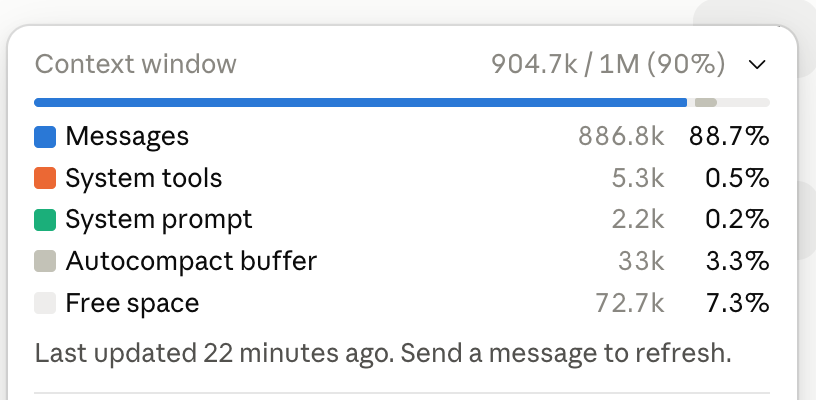
The author tests fast-jev-compaction on their own session, reporting Jev filtering unnecessary tool calls in one second to reduce nearly a million tokens to 86K. The result is session-specific.
 CASE 05Demo
The interaction demo uses Jev to filter an emoji collection from a semantic query, turning a search box into a visual picker.
 CASE 06Demo
The experiment combines Jev and json-render around existing components, actions, and a design system. The author claims millisecond rendering but does not provide full latency measurements.
 CASE 07Demo
A Jev-powered demo explores intelligent copy/paste interactions; the post does not disclose the rules used to choose the pasted result.
 CASE 08Demo
Jev controls traffic lights in a city simulation. The author reports average waiting rising by over 600% when Jev is disabled, without real-road validation.
 CASE 09Demo
Astra supplies planning and learned skills while Jev drives rapid movement. The author reports defeating Minecraft’s Ender Dragon in 8 minutes 43 seconds for under $1.
 CASE 10Demo
Jev analyzes hooks, formats, offers, CTAs, awareness stages, and landing-page mismatches across 37 brands, with forty seconds and nine cents reported by the author.
 CASE 11Demo
The author builds a Jev-powered Mac voice assistant and demonstrates Notes opening before the full spoken request has finished.
 CASE 12Demo
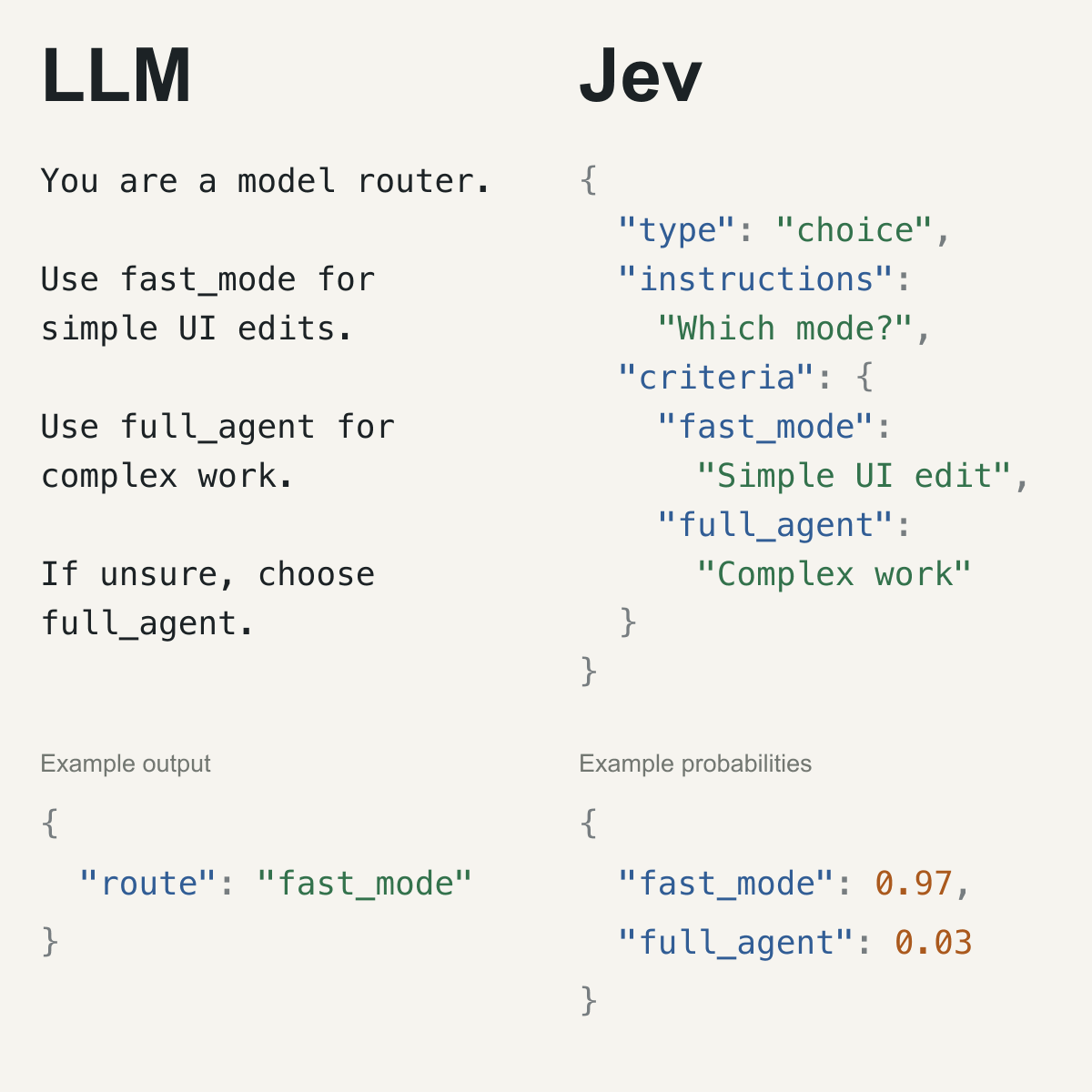
A simplified comparison shows Jev and an LLM classifying prompt difficulty. It illustrates routing without proving broad speed or cost claims.
 CASE 13Demo
The author demonstrates an interaction exploring whether Jev understands color and its use in UI. Color input format, criteria, and accuracy are not specified.
 CASE 14Evaluation
CUA released CUA-S1-FORMS, and reports of its form-filling evaluation give hosted Jev 83.6% versus 99.7% for the specialist model. This comparison concerns a specific form task and different deployment setups.
 CASE 15Integration
The author reports a massively parallel Jev browser-testing suite that tries to break each release. Coverage, failure counts, and detailed cost figures are not disclosed.
 CASE 16Demo
Jev chooses buy or sell from an asset pair’s price feed, while code places orders on Kuru through Monad. The author reports real trades but provides no verified profitability.
 CASE 17Demo
The author presents a driving simulator prototype using Jev for decisions. The post’s Tesla comparison does not demonstrate road-driving capability.
 CASE 18Demo
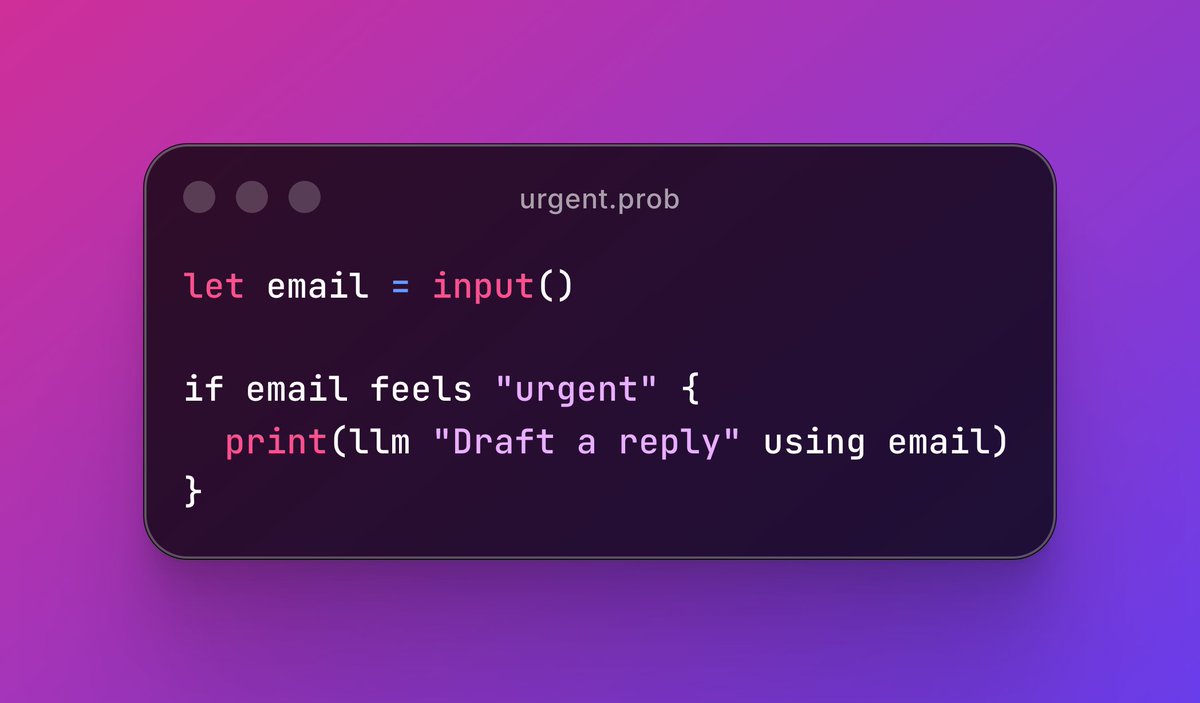
The toy language adds feels questions, description-based match routing, and while loops: Jev decides, an LLM writes, and ordinary code connects them.
 CASE 19Evaluation
The author lets Jev choose from a few hundred English words and punctuation to construct text. This is a constrained selection experiment, not native free-text generation.
 CASE 20Demo
The author demonstrates Jev playing fifty Subway Surfers games at once for a reported cost under a cent, without per-game scores or survival rates.
 CASE 21Evaluation
The author reports Jev matching 384 stories to 15 brands in 24.9 seconds. The simultaneous Opus comparison uses the same feed within a fixed time window rather than comparing completed full runs.
 CASE 22Evaluation
The author uses Jev to judge link relevance and existing anchor text, reporting 586 pages processed and 584 links placed in 45.1 seconds. The Opus comparison stops when Jev finishes; full-run Opus cost is extrapolated.
 CASE 23Demo
A speed-focused demo uses Jev to identify negative chat comments for removal; it does not report moderation accuracy or an appeals workflow.
 CASE 24Demo
The author reports classifying 500 emails with Jev in seconds for 3.5 cents. The post does not establish classification accuracy.
 CASE 25Demo
The author integrates Jev into a MAGI-style app for quickly judging light everyday dilemmas on desktop or mobile. It is an entertainment demo without advice-quality evaluation.
 CASE 26Integration
OpenRouter announces beta access that accepts application state and typed questions and returns structured decisions with probabilities, documenting a gateway integration route.
 CASE 27Demo
Drape’s experiment sends speech transcripts and current outfit context to Jev, which chooses items from a closet for a live virtual try-on presentation.
 CASE 28Demo
Speech transcripts go to Jev for action probabilities that trigger browser clicks; the author reports roughly 300 ms and $0.0002 per decision.
 CASE 29Tutorial
The tutorial maps agent branches to Choice, Score, and Noul, batches independent questions, and connects selected actions to fresh-state verification while code retains execution control.
 CASE 30Demo
The author uses Jev to choose combat actions for four different characters in self-play. Response speed and low costs are author descriptions rather than formal win-rate or baseline measurements.
 CASE 31Evaluation
The author applies Jev to an existing tax-document pipeline, reporting classification across their corpus at about $0.001 per page with lower latency and cost. Results apply to that private corpus.
 CASE 32Demo
Gojiberry’s team uses Jev to estimate message performance, confidence, and mismatches for 700 leads, reporting 40 seconds and $0.09. Predictions are not validated against actual conversions.
 CASE 33Tutorial
The timestamped tutorial covers Jev setup and three demonstrations: a voice-controlled browser, AI memory, and YouTube prediction, making task-specific implementation sections easy to locate.
 CASE 34Demo
The author connects Jev decisions to Super Mario Bros. and shows gameplay, without reporting a completion rate.
 CASE 35Integration
Jev filters rows by natural-language criteria such as remote-work suitability. The author reports about one second for 129 rows and six milliseconds on a cached rerun.
 CASE 36Demo
The author demonstrates Jev structured output for real-time level construction. The post does not specify level representation, playability checks, or performance measurements.
 CASE 37Evaluation
Jev reads a diff and returns probabilities for fourteen checks such as secrets, injection, and auth. Code builds the verdict, escalating uncertain critical checks to a person or larger model.
 CASE 38Evaluation
The reported Snake comparison uses local Laya and the Jev 1.13.0 cloud API. Jev’s network round trips are included, so the result is not a pure model-speed comparison.
 CASE 39Tutorial
The tutorial covers requesting access, installing the TypeSafe Skill, creating an API key, and invoking it in tasks. Its unsupported multimodal-input statement is not adopted as a capability claim.
 CASE 40Demo
The launcher sends intents such as “the PDF I just downloaded” to Jev, ranks the relevant file first, and shows confidence on each keystroke; roughly 100 ms is author-reported.
 CASE 41Evaluation
In reported five-minute games with one API call per move, Jev won against Fable on time but lost to Astra by checkmate. Fast decisions did not guarantee stronger chess.
 CASE 42Evaluation
The author reproduces a news-matching workflow that classifies 428 stories for 15 brands with structured intent labels. They report Jev finishing in 28 seconds while DeepSeek V4.1 Flash processes six stories in the same window; the comparison depends on this implementation.
 CASE 43Tutorial
The guide installs TypeSafe’s SDK, builds a logged dry-run router, and inserts Jev before browsing, research, retries, or extra bots, with shadow testing before activation.
 CASE 44Evaluation
The author tests Jev, Luna, Sonnet, and Flash on email classification and supplies a comparison video. Jev is described as faster, without numerical latency or classification-quality results.
 CASE 45Demo
The author builds a Jev site with freely entered A and B values, such as whether a banana counts as a snack, demonstrating lightweight conceptual classification.
 CASE 46Evaluation
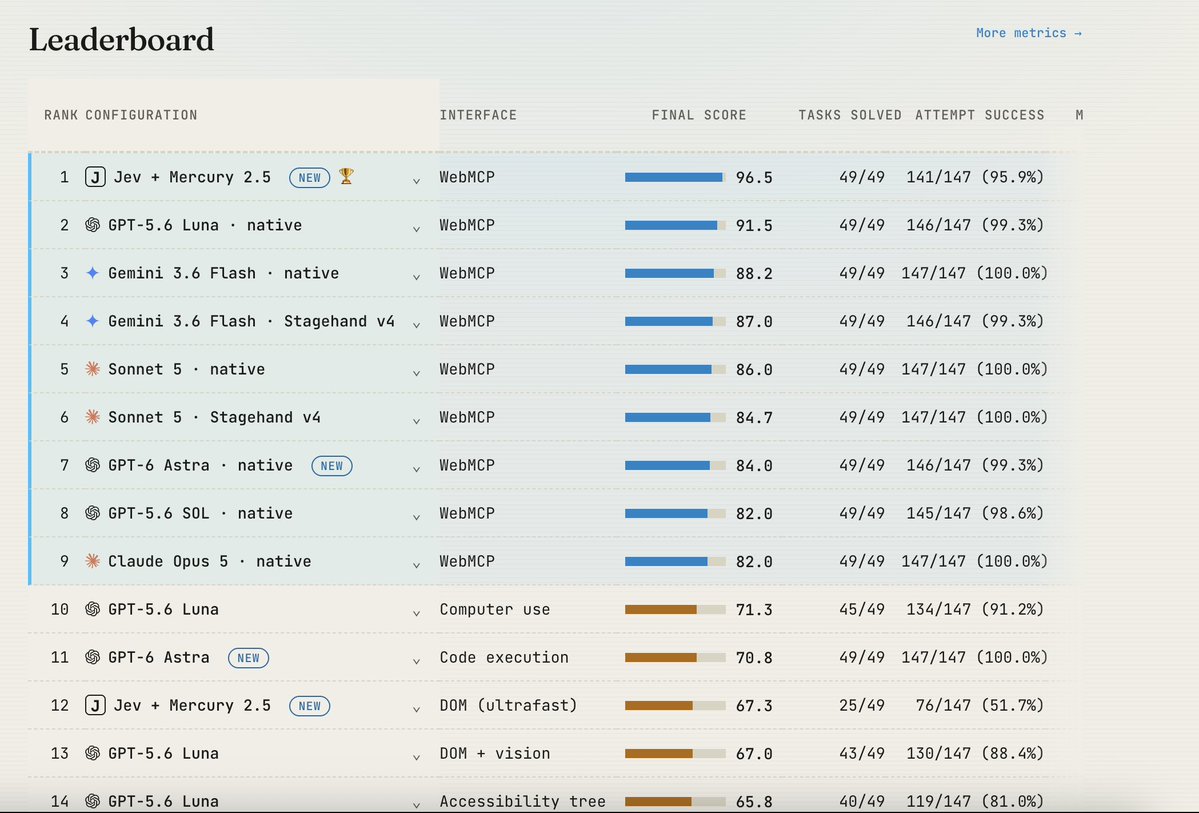
Jev selects tools, Mercury 2.5 generates arguments, and WebMCP exposes actions. The authors report 25/49 tasks for their modified Ultrafast versus 49/49 for the combined setup; results depend on the full harness.
 CASE 47Evaluation
Firstmate uses Jev to select model reasoning effort. In the author’s 25-task comparison, results matched Fable while total dispatch cost fell 71% and wall time 90%, including LLM tool-call overhead.
 CASE 48Evaluation
DeepSeek V4 Flash first summarized 1,018 papers for a reported $3.99; Jev then classified titles and summaries into 24 topics for $0.08 at 256 ms median latency per paper. The new tags were still awaiting evaluation before replacing the live site’s tags.
Showing 48 / 496
BUILD WITH EVOLINK / 04
If your workflow also needs text, image, or video generation, browse the models available on EvoLink. Refer to each original source for Jev integration details.