Explore 42 public observations of Haiku 5.5 across RAG, classification, subagents, websites, games and code-driven animation. Check original sources, model roles, reported results and limits.
42 CASE OBSERVATIONSFAILURES & LIMITS INCLUDED3 LANGUAGES
These 42 observations include creator accounts, official or vendor demos, mixed results and failures. They are not counts of production customers or independent successful projects. This site has not independently rerun the model tasks. Companion models, supplied music, drawing and rendering tools retain their roles; code-driven animation is not native video generation. Seven additional leads remain pending and are excluded from the case count.
42case observations
7task categories
3English, Chinese, and Japanese
HOW TO USE / 02
From case discovery to workflow validation
Find a related task, review the original evidence and limitations, then test with your own inputs and acceptance criteria.
01
Find a related task
Choose documents, code, subagents, websites, games or graphics.
02
Check the original source
Open the author link for the original result, corrections and failures.
03
Identify model and tool roles
Separate Haiku, the coordinating model, music, drawing and rendering.
04
Evaluate your own result
Record inputs, actual model, costs, retries and task completion.
REAL CREATOR CASES / 03
42 Haiku 5.5 case observations
Sources come from a fixed Oct 8, 2026 X and HN collection. X posts had more than 30 likes at collection; HN metrics are not treated as X likes. Text entries retain author-reported outcomes. Clips without individual model attribution are not shown as standalone Haiku outputs.
42 cases
CASE 01Demo
Business & documents
Migrating in-game AI chat from Luna to Haiku
The creator reports switching the game's AI chat from Luna to Haiku with subscription API credits. The attached comparison reports response time falling from about 5.7 to 2.9 seconds. No request logs, concurrency figures or bills after the credits run out are provided; this does not establish lasting free operation.
The creator reports using Haiku 5.5 in a mail tool, finding it inexpensive and substantially improved over 4.5. The post does not identify whether it writes, classifies or performs another email task. No quantitative quality, latency or billing evidence is supplied.
A developer reports testing Haiku in a RAG system containing over 3,000 A4-sized Cloudflare technical documents, with the best quality × speed / price ratio among over 100 tested models. Attribution to 5.5 comes from the release-thread context, without a model ID. The retriever, evaluation set, citation accuracy and bills are undisclosed.
The author compares the same classification work with Haiku 5.5 and Luna, reporting synchronous costs of $0.42 and $0.31 respectively and more Haiku input and output tokens. Labels, accuracy, caching and discounts are not disclosed. These are reported bills, not an independently reconstructed cost formula.
Document parsing: tables, reading order and charts
An OpenDocRouter / LlamaIndex-associated founder reports parsing at roughly $1.2 per 1,000 pages, with stronger tables and reading order but weaker charts, semantic formatting and bounding boxes. The attachment is a comparison table, not original pages and per-page parsing outputs. This is a vendor evaluation and product promotion, not independent customer production evidence. Source disclosure: official, employee or vendor self-promotion.
The DataAnalyticsBench author reports $0.38 for 40 questions: straightforward analysis went well, while deeper statistical analysis was weaker. Luna reportedly did slightly better at about 30% of Haiku's cost. This is a concrete executed evaluation, but the question set and results have not been independently rerun here.
A developer moved an example agentic end-to-end test suite from Luna to Haiku 5.5. They report faster execution, more tokens and more mistakes, and intend to switch back. The clip shows terminals and test runs; complete inputs and failure counts are absent. One suite's rollback does not establish a general coding regression.
Egg-drop design search with Opus and ten Haiku agents
An official simulation compares Opus alone with Opus coordinating ten Haiku agents. The combined run reportedly reached the 32 m target in about 58 seconds with 86 designs and $0.14; Opus alone ended around 3m 37s, 25 designs and $0.47. Four posts show the same demo. This is not a physical experiment; billing is unverified and the joint output is not Haiku's alone. Source disclosure: official, employee or vendor self-promotion.
An Anthropic employee reports using multiple Haiku 5.5 agents to stream drawing commands onto a shared canvas. The demonstration shows map sections gradually filling in with multiple progress tracks. Total calls, cost and geographic accuracy are not evaluated; model list prices do not establish whole-workflow savings. Source disclosure: official, employee or vendor self-promotion.
The AI Village operator reports that Haiku 5.5 repeatedly checked Gmail for instructions in an autonomous environment. The accompanying explanation of the autonomy shift was written by GLM-5.2, not Haiku. The behavior report and preferences post belong to one project; neither the guide nor preferences are counted as separate Haiku outputs. Full behavioral logs are unavailable. Source disclosure: official, employee or vendor self-promotion.
The creator asked Haiku 5.5 for 100 visually distinct HTML files and linked results and prompts. They report no broken files and some playable mini-games. The figure is the creator's output count: this site has not run every linked file, and it does not represent 100 independent users or cases.
The creator used Haiku 5.5 Ultracode with “a website about yourself” and reports 1h 30m of work. The recording shows a homepage, model introduction and code sections. It demonstrates a page result, not that every link and interaction works; source code and task cost are not provided.
A tester compared Haiku 5.5 and Opus 5.5 on the same image-to-HTML task. They report that Haiku failed to reproduce the complex design and delegated work to Opus. The goal was faithful reproduction, not aesthetic preference. Work finished by Opus is not a standalone Haiku success; linked results were not independently rerun here.
The creator attributes the game to Haiku 5.5 Ultracode. The recording shows poolside characters, rounds, scores and leaderboard changes. The supplied report sampled frames showing interface state changes; neither the game rules nor the complete code have been independently checked by playing the game.
The creator reports about one hour of work using 1% of a five-hour allowance. The supplied footage review identifies forest, dungeon and other 3D exploration scenes. A separate post about four unnamed tasks is not joined to this work. Allowance percentage is not an API bill, and this game has not been independently played here.
The benchmark author reports a Haiku run taking 19 minutes and $0.16. After initially praising it as unmatched for the price, they corrected the claim: Luna was broadly comparable, with different ghost-logic and map defects. That correction is retained. The games have not been independently played here.
The creator asked Haiku 5.5 to explain itself in a video and reports roughly 20 minutes from start to MP4 export. The estimated cost of a few dozen yen is explicitly uncertain. Complete instructions, code, narration provenance and bills are absent; this is not evidence of native video generation.
The creator explicitly credits Opus 5.5 working with Haiku 5.5 subagents. The clip shows beach castles, block characters, flowers and a later pixel character. Individual subagent contributions are not disclosed, so the complete animation cannot be attributed to Haiku alone.
The creator compares three identical prompts across Haiku and Luna, reporting totals of $3.00 and $0.19. They prefer Haiku's map and landmark, with typography close. The separate 81-province map post reports 53.8% boundary overlap for Haiku and is merged with the same map in the collection. Costs and scoring remain author claims; the scoring method has not been reproduced.
The creator gave Haiku and Sonnet the same request: a miniature city with ten linked stages ending in a rocket launch. They report that both reached the launch despite rough visuals. Sampled frames do not verify every stage or causal connection, so the final launch image is not proof of full task completion.
The creator reports an 80-second film whose frames were all drawn with code: dough at night, a morning stall and gulls by a ferry. They supplied the music and describe the rest as a one-prompt first draft made in an hour. Haiku did not generate the music; exact full instructions and code are absent, and native video output is not established.
The creator asked Haiku to write 20 poems and explicitly says every video frame was drawn with JavaScript. The supplied frame review shows different poems with webs, branches and dandelion-like graphics. It confirms a multi-part visual presentation, not verification of every poem's form or independent execution of the code.
The author reports a bicycle-riding pelican SVG at low effort in 7 seconds for 0.0936 cents, versus max in 5m 9s for 3.3826 cents. They prefer frames at medium and above; another commenter identifies structural defects even there. X notes and HN details are grouped as one named test. Not all SVGs were rerendered; one familiar task is not an overall capability score.
A post labels the scene “Haiku 5.5 Voxel Pagoda.” The supplied review describes a rotating island growing from a base into a pagoda, flowers and grass. It is unclear whether the poster executed the task or shared another person's work. Retain the attributed showcase without treating it as an independent test or proof of unlimited usage.
Atomic Chat compares the same type of animated voxel island using its API service. The post states Haiku $24.96 and Luna $1.91, while the sampled video shows Luna $1.96. Both amounts are retained without reconstructing an exact cost multiple. This vendor demonstration lacks complete bills and task settings. Source disclosure: official, employee or vendor self-promotion.
The root post reports Haiku's output from the same prompt; its saved quoted parent identifies the task as Mechanical Bee. The clip shows a mechanical bee, changing wings and interface controls. This explicit quote relation establishes the task, not an assumption about the author. The engine, native 3D ability and controls have not been independently verified.
BridgeBench reports Haiku at 6m 58s and $0.05 versus Luna at 1m 5s and under $0.01 for its rocket-launch task. It describes Haiku's scene as clean but slower and more expensive. This is the evaluator's own promotional demonstration; original instructions, settings and acceptance details are absent. It is not merged into a win rate with another creator's rocket test. Source disclosure: official, employee or vendor self-promotion.
The author describes Haiku painting with code and compares it with Luna and Sonnet. Two attached clips show colored curves, floating shapes and changing trails, but individual clips are not clearly mapped to models. The attributed task is retained as a text report; neither clip is presented as a confirmed standalone Haiku output.
The source explicitly identifies a Three.js zebra scene. Later posts reuse the same Haiku footage in two- and three-model comparisons or commentary. The creator prefers Haiku's graphics. The shared zebra, grassland and sunset sequence is one observation, not three independent successes, and it is code-rendered work rather than native image or video generation.
Another creator gave Haiku and Luna the same rocket-launch prompt at max effort. They report roughly two minutes for each, with Haiku $1.30 and Luna $1.50, and prefer Haiku's scene. The environment and accounting differ from BridgeBench, so these results cannot simply cancel each other into a universal winner.
BridgeMind's BridgeBench comparison reports that Haiku produced a yellow cylinder without the requested glass shell or lava, taking 4m 34s and $0.03. The sampled comparison shows the yellow column beside Luna's orange interior forms. This records a visible limitation in one example, without independent execution or rerendering. Source disclosure: official, employee or vendor self-promotion.
The creator shares an English prompt asking for a launch video with 2D, 3D, music and drawing through code, and claims a one-shot result. The video shows model titles, curves, geometry and comparisons. Neither the audio nor the one-shot process was independently checked. Preserve the source prompt excerpt without claiming native video generation.
The creator gave Haiku and Sonnet the same Tesla-style motor animation task. Reported times are 11m 13s and 33m 3s; the video displays $0.44 and $4.98. The comparison shows rotors, coils, cutaways and exploded parts. Bills are unverified, and visual detail does not establish engineering or physical accuracy.
The footage supplies the elevated tracks, trains and castle-like scene absent from the caption. The creator compares Haiku max with Space Bunny Alpha high on the same prompt: about 30 minutes versus six hours, preferring the latter's revised result. The post's separate 2% allowance claim covers four unnamed projects, not this scene alone. Track connections are unverified.
The caption attributes the work to Haiku; the supplied video review identifies a multilevel curved track with red cars changing position. Interaction, physics and implementation are unspecified. This is an animation showcase, not a verified completed racing game.
The creator used the same prompt at the highest available reasoning settings, with Haiku in Claude Code and Grok in Grok Build. They report 27m/$0.80 versus 35m/$4.10 and prefer Haiku. The scene includes a moon, towers, cherry blossoms, riverside and dragon. Different environments prevent an isolated model comparison; the rendering engine is unspecified.
The creator reports making the film with Haiku in under an hour. The supplied frame review shows a glowing galaxy, beams, planets and debris rings. The toolchain, assets and audio provenance are undisclosed; the post does not establish native video generation.
The creator attributes a reference-photo portrait to Haiku 5.5. The recording shows a paint-like interface progressively adding hair, glasses, facial features and clothing. Without execution logs, it is unclear whether the control method was computer use, scripted drawing or something else.
The creator gave Haiku high and Opus extra the same request for a sunset in a world drawn with code. They report Haiku adding a day-night cycle and a pig, while Opus produced a different animal scene. The poster's preference is not a shared acceptance test; the engine and complete interactions are unverified.
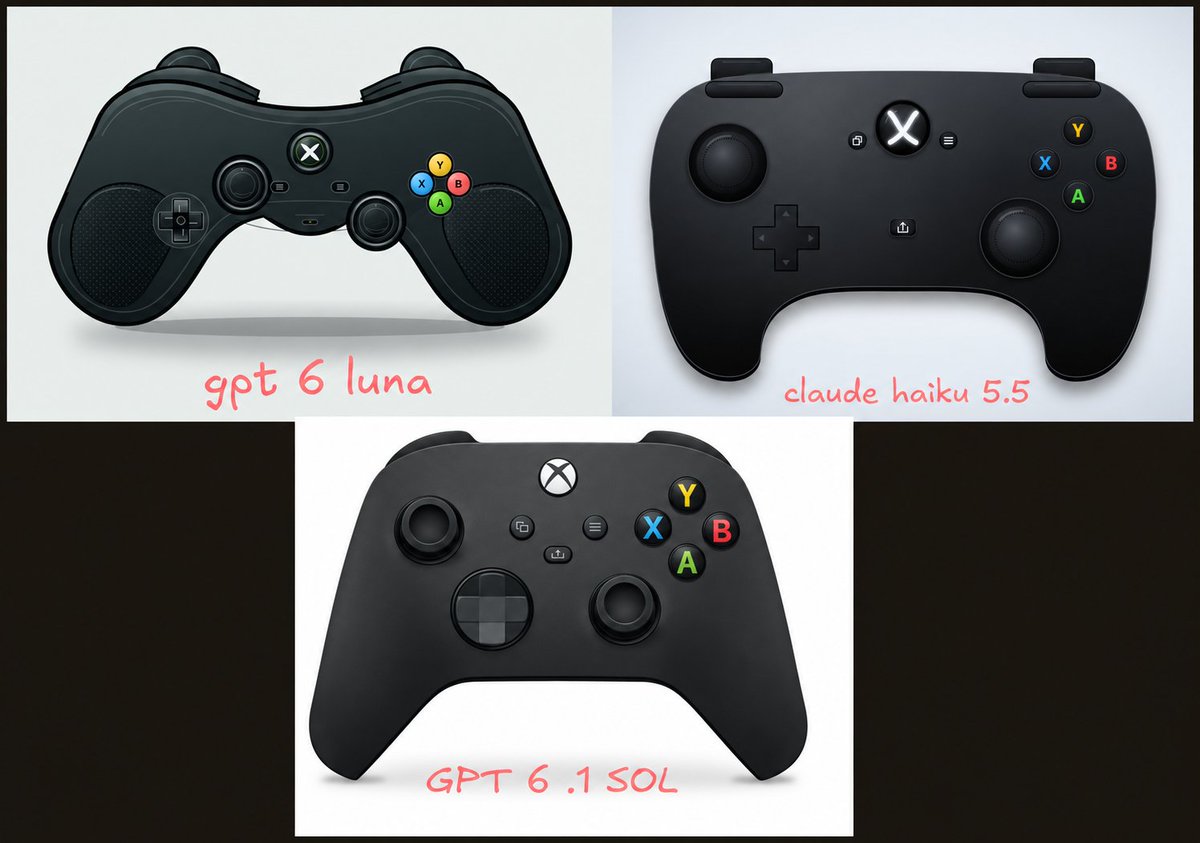
The creator compares Haiku, Luna and Sol, preferring Haiku to Luna but Sol to both. The labeled image shows three controllers. The format is unspecified: an image alone cannot establish an SVG, usable 3D asset or native image-generation output.
Two recordings show a six-finger hand being presented to Haiku, which answers five. They are grouped as one error observation on the same input subject, without asserting the same request or independent reproduction. The supplied review sampled both recordings; no repeated trial supports a general conclusion about vision ability.
The author's child comment names the CSS solar-system task; its parent explicitly identifies Haiku 5.5 and links a comparison. They report a noticeable difference from Luna without a detailed scoring table. Attribution follows that parent-child relation. The external animation was not independently run, and the subjective judgment is not converted into a win rate.
Check currently available models on EvoLink. Prepare inputs and tools, and record the actual model, cost, time, retries and results. This collection does not promise availability of a particular model API.

 CASE 01Demo